Github Repo : GitHub - powerofaisinstudy-debug/Megabots2026- · GitHub
Hi everyone,
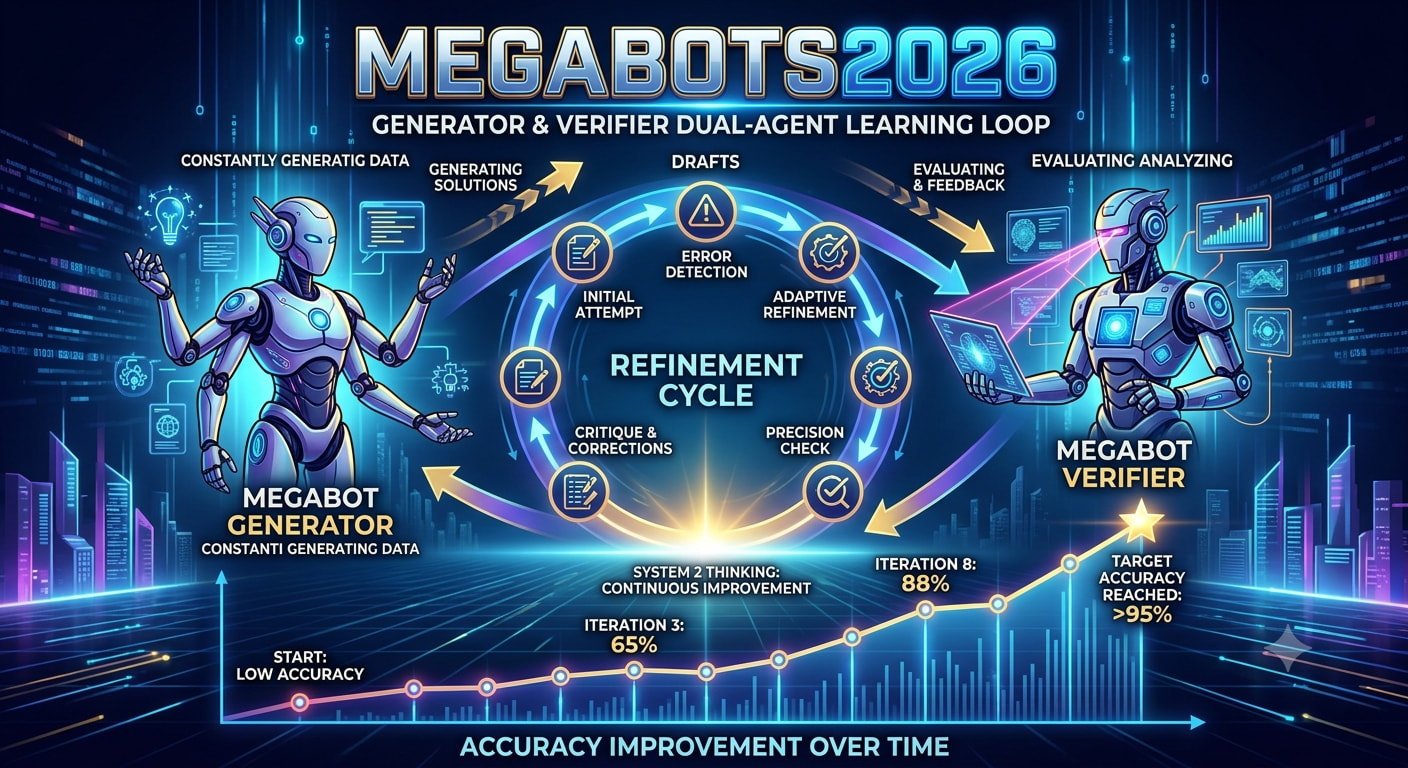
I wanted to share an architectural design concept I am exploring for a project called Megabots2026. The goal is to scale deep learning task accuracy by 10x by completely decoupling execution from validation into a specialized, dual-agent closed loop using PyTorch.
The Core Concept
Instead of training a single massive model to handle both task execution and self-validation (which inherently introduces self-evaluation bias), the architecture splits the workload into two distinct nn.Module networks:
-
Generator Bot: Focuses purely on execution speed, output generation, and action spaces.
-
Verifier Bot: Focuses strictly on validation, constraint checking, physics/rule checking, and error scoring.
The Feedback Loop
The two networks train each other in a high-speed simulation loop before any real-world execution:
[Generator Output] ➔ [Verifier Evaluation] ➔ [Feedback Gradient] ➔ [Generator Correction]
By isolating the “creation” and “verification” steps mathematically, the Verifier’s evaluation dynamically sharpens the Generator’s weights over successive training steps, driving the output toward maximum absolute accuracy without standard single-model optimization bottlenecks.
I have set up a GitHub repository to prototype this idea, but I wanted to open a discussion here with the PyTorch community:
-
What are the most stable mathematical strategies you’ve found for handling the loss handoff between two decoupled optimizers?
-
Are there native PyTorch components or advanced multi-task optimization concepts you would recommend to keep this dual-agent coordination stable at scale?
Looking forward to hearing your thoughts and ideas!