How to get around the following error with nn.CrossEntrophyLoss() ?
Note: I tried using nn.BCELoss(), but it resulted in different error: ValueError: Using a target size (torch.Size([4])) that is different to the input size (torch.Size([4, 3, 32, 32])) is deprecated. Please ensure they have the same size.
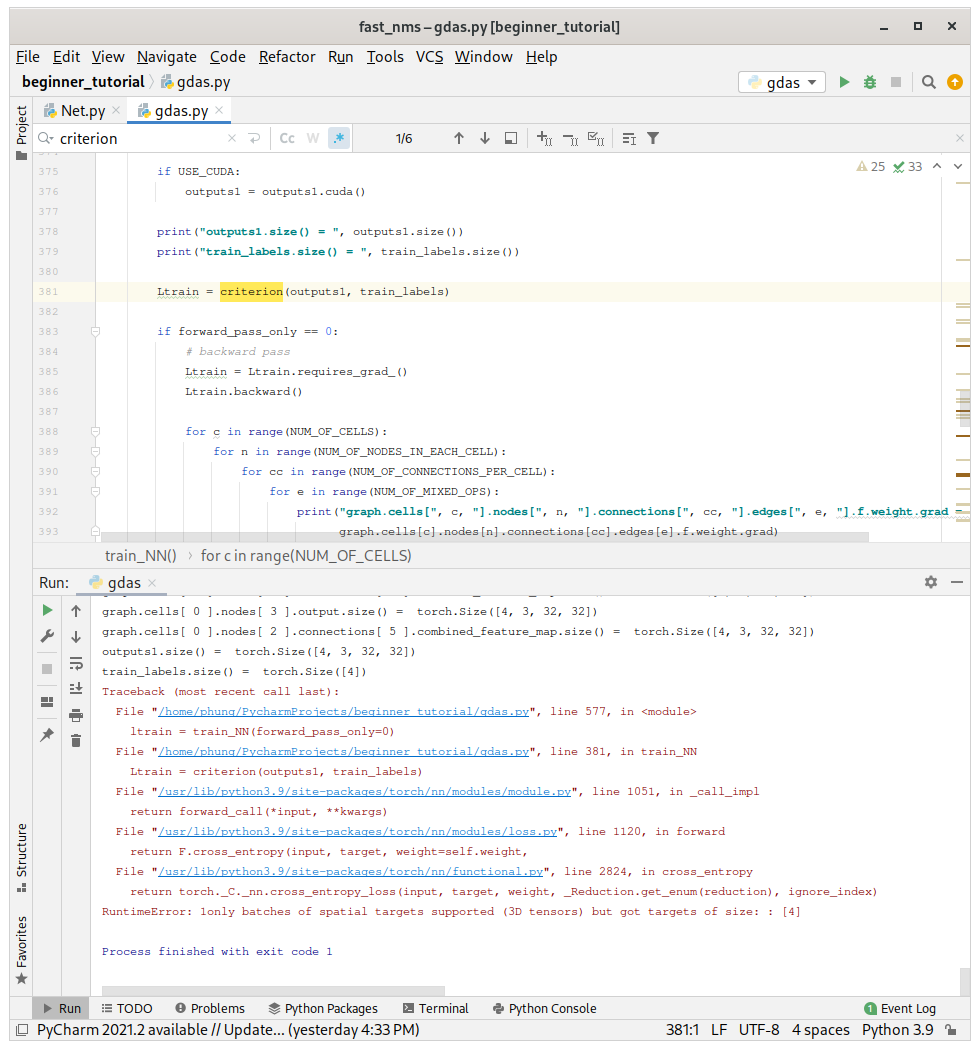
# https://github.com/D-X-Y/AutoDL-Projects/issues/99

import torch
import torch.utils.data
import torch.nn as nn
import torch.nn.functional as F
import torch.optim as optim

import torchvision
import torchvision.transforms as transforms

# import numpy as np

USE_CUDA = torch.cuda.is_available()

# https://arxiv.org/pdf/1806.09055.pdf#page=12
TEST_DATASET_RATIO = 0.5  # 50 percent of the dataset is dedicated for testing purpose
BATCH_SIZE = 4
NUM_OF_IMAGE_CHANNELS = 3  # RGB
IMAGE_HEIGHT = 32
IMAGE_WIDTH = 32
NUM_OF_IMAGE_CLASSES = 10

SIZE_OF_HIDDEN_LAYERS = 64
NUM_EPOCHS = 1
LEARNING_RATE = 0.025
MOMENTUM = 0.9
NUM_OF_CELLS = 8
NUM_OF_MIXED_OPS = 4
NUM_OF_PREVIOUS_CELLS_OUTPUTS = 2  # last_cell_output , second_last_cell_output
NUM_OF_NODES_IN_EACH_CELL = 4
NUM_OF_CONNECTIONS_PER_CELL = NUM_OF_PREVIOUS_CELLS_OUTPUTS + NUM_OF_NODES_IN_EACH_CELL
NUM_OF_CHANNELS = 16
INTERVAL_BETWEEN_REDUCTION_CELLS = 3
PREVIOUS_PREVIOUS = 2  # (n-2)
REDUCTION_STRIDE = 2
NORMAL_STRIDE = 1
TAU_GUMBEL = 0.5
EDGE_WEIGHTS_NETWORK_IN_SIZE = 5
EDGE_WEIGHTS_NETWORK_OUT_SIZE = 2

# https://pytorch.org/tutorials/beginner/blitz/cifar10_tutorial.html
transform = transforms.Compose(
    [transforms.ToTensor(),
     transforms.Normalize((0.5, 0.5, 0.5), (0.5, 0.5, 0.5))])

trainset = torchvision.datasets.CIFAR10(root='./data', train=True,
                                        download=True, transform=transform)
trainloader = torch.utils.data.DataLoader(trainset, batch_size=BATCH_SIZE,
                                          shuffle=True, num_workers=2)

valset = torchvision.datasets.CIFAR10(root='./data', train=False,
                                      download=True, transform=transform)
valloader = torch.utils.data.DataLoader(valset, batch_size=BATCH_SIZE,
                                        shuffle=False, num_workers=2)

classes = ('plane', 'car', 'bird', 'cat',
           'deer', 'dog', 'frog', 'horse', 'ship', 'truck')

TRAIN_BATCH_SIZE = int(len(trainset) * (1 - TEST_DATASET_RATIO))


# https://discordapp.com/channels/687504710118146232/703298739732873296/853270183649083433
# for training for edge weights as well as internal NN function weights
class Edge(nn.Module):

    def __init__(self):
        super(Edge, self).__init__()

        # https://stackoverflow.com/a/51027227/8776167
        # self.linear = nn.Linear(EDGE_WEIGHTS_NETWORK_IN_SIZE, EDGE_WEIGHTS_NETWORK_OUT_SIZE)
        # https://pytorch.org/docs/stable/generated/torch.nn.parameter.Parameter.html
        self.weights = nn.Parameter(torch.zeros(1),
                                    requires_grad=True)  # for edge weights, not for internal NN function weights

    def __freeze_w(self):
        self.weights.requires_grad = False

    def __unfreeze_w(self):
        self.weights.requires_grad = True

    def __freeze_f(self):
        for param in self.f.parameters():
            param.requires_grad = False

    def __unfreeze_f(self):
        for param in self.f.parameters():
            param.requires_grad = True

    # for NN functions internal weights training
    def forward_f(self, x):
        self.__unfreeze_f()
        self.__freeze_w()

        # inheritance in python classes and SOLID principles
        # https://en.wikipedia.org/wiki/SOLID
        # https://blog.cleancoder.com/uncle-bob/2020/10/18/Solid-Relevance.html
        return self.f(x)

    # self-defined initial NAS architecture, for supernet architecture edge weight training
    def forward_edge(self, x):
        self.__freeze_f()
        self.__unfreeze_w()

        return x * self.weights


class ConvEdge(Edge):
    def __init__(self, stride):
        super().__init__()
        self.f = nn.Conv2d(in_channels=3, out_channels=3, kernel_size=(3, 3), stride=(stride, stride), padding=1)


class LinearEdge(Edge):
    def __init__(self):
        super().__init__()
        self.f = nn.Linear(84, 10)


class MaxPoolEdge(Edge):
    def __init__(self, stride):
        super().__init__()
        self.f = nn.MaxPool2d(kernel_size=3, stride=stride, padding=1, ceil_mode=True)


class AvgPoolEdge(Edge):
    def __init__(self, stride):
        super().__init__()
        self.f = nn.AvgPool2d(kernel_size=3, stride=stride, padding=1, ceil_mode=True)


class Skip(nn.Module):
    def forward(self, x):
        return x


class SkipEdge(Edge):
    def __init__(self):
        super().__init__()
        self.f = Skip()


# to collect and manage different edges between 2 nodes
class Connection(nn.Module):
    def __init__(self, stride):
        super(Connection, self).__init__()

        if USE_CUDA:
            # creates distinct edges and references each of them in a list (self.edges)
            # self.linear_edge = LinearEdge().cuda()
            self.conv2d_edge = ConvEdge(stride).cuda()
            self.maxpool_edge = MaxPoolEdge(stride).cuda()
            self.avgpool_edge = AvgPoolEdge(stride).cuda()
            self.skip_edge = SkipEdge().cuda()

        else:
            # creates distinct edges and references each of them in a list (self.edges)
            # self.linear_edge = LinearEdge()
            self.conv2d_edge = ConvEdge(stride)
            self.maxpool_edge = MaxPoolEdge(stride)
            self.avgpool_edge = AvgPoolEdge(stride)
            self.skip_edge = SkipEdge()

        self.edges = [self.conv2d_edge, self.maxpool_edge, self.avgpool_edge, self.skip_edge]
        self.edge_weights = torch.zeros(NUM_OF_MIXED_OPS, requires_grad=True)

        # for approximate architecture gradient
        self.f_weights = [None] * NUM_OF_MIXED_OPS
        self.f_weights_backup = [None] * NUM_OF_MIXED_OPS
        self.weight_plus = torch.zeros(NUM_OF_MIXED_OPS, requires_grad=True)
        self.weight_minus = torch.zeros(NUM_OF_MIXED_OPS, requires_grad=True)

        # use linear transformation (weighted summation) to combine results from different edges
        self.combined_feature_map = torch.zeros([BATCH_SIZE, NUM_OF_IMAGE_CHANNELS, IMAGE_HEIGHT, IMAGE_WIDTH],
                                                requires_grad=True)

        if USE_CUDA:
            self.combined_feature_map = self.combined_feature_map.cuda()

        for e in range(NUM_OF_MIXED_OPS):
            with torch.no_grad():
                self.edge_weights[e] = self.edges[e].weights

            # https://stackoverflow.com/a/45024500/8776167 extracts the weights learned through NN functions
            # self.f_weights[e] = list(self.edges[e].parameters())

        # Refer to GDAS equations (5) and (6)
        # if one_hot is already there, would summation be required given that all other entries are forced to 0 ?
        # It's not required, but you don't know, which index is one hot encoded 1.
        # https://pytorch.org/docs/stable/nn.functional.html#gumbel-softmax

        gumbel = F.gumbel_softmax(self.edge_weights, tau=TAU_GUMBEL, hard=True)
        self.chosen_edge = torch.argmax(gumbel, dim=0)  # converts one-hot encoding into integer


# to collect and manage multiple different connections between a particular node and its neighbouring nodes
class Node(nn.Module):
    def __init__(self, stride):
        super(Node, self).__init__()

        # two types of output connections
        # Type 1: (multiple edges) output connects to the input of the other intermediate nodes
        # Type 2: (single edge) output connects directly to the final output node

        # Type 1
        self.connections = nn.ModuleList([Connection(stride) for i in range(NUM_OF_CONNECTIONS_PER_CELL)])

        # Type 2
        # depends on PREVIOUS node's Type 1 output
        self.output = torch.zeros([BATCH_SIZE, NUM_OF_IMAGE_CHANNELS, IMAGE_HEIGHT, IMAGE_WIDTH],
                                                requires_grad=True)  # for initialization

        if USE_CUDA:
            self.output = self.output.cuda()


# to manage all nodes within a cell
class Cell(nn.Module):
    def __init__(self, stride):
        super(Cell, self).__init__()

        # all the coloured edges inside
        # https://user-images.githubusercontent.com/3324659/117573177-20ea9a80-b109-11eb-9418-16e22e684164.png
        # A single cell contains 'NUM_OF_NODES_IN_EACH_CELL' distinct nodes
        # for the k-th node, we have (k+1) preceding nodes.
        # Each intermediate state, 0->3 ('NUM_OF_NODES_IN_EACH_CELL-1'),
        # is connected to each previous intermediate state
        # as well as the output of the previous two cells, c_{k-2} and c_{k-1} (after a preprocessing layer).
        # previous_previous_cell_output = c_{k-2}
        # previous_cell_output = c{k-1}
        self.nodes = nn.ModuleList([Node(stride) for i in range(NUM_OF_NODES_IN_EACH_CELL)])

        # just for variables initialization
        self.previous_cell = 0
        self.previous_previous_cell = 0
        self.output = torch.zeros([BATCH_SIZE, NUM_OF_IMAGE_CHANNELS, IMAGE_HEIGHT, IMAGE_WIDTH],
                                                requires_grad=True)

        if USE_CUDA:
            self.output = self.output.cuda()

        for n in range(NUM_OF_NODES_IN_EACH_CELL):
            # 'add' then 'concat' feature maps from different nodes
            # needs to take care of tensor dimension mismatch
            # See https://github.com/D-X-Y/AutoDL-Projects/issues/99#issuecomment-869100416
            self.output = self.output + self.nodes[n].output


# to manage all nodes
class Graph(nn.Module):
    def __init__(self):
        super(Graph, self).__init__()

        stride = 0  # just to initialize a variable

        for i in range(NUM_OF_CELLS):
            if i % INTERVAL_BETWEEN_REDUCTION_CELLS == 0:
                stride = REDUCTION_STRIDE  # to emulate reduction cell by using normal cell with stride=2
            else:
                stride = NORMAL_STRIDE  # normal cell

        self.cells = nn.ModuleList([Cell(stride) for i in range(NUM_OF_CELLS)])


# https://translate.google.com/translate?sl=auto&tl=en&u=http://khanrc.github.io/nas-4-darts-tutorial.html
def train_NN(forward_pass_only):
    print("Entering train_NN(), forward_pass_only = ", forward_pass_only)

    graph = Graph()

    if USE_CUDA:
        graph = graph.cuda()

    # criterion = nn.CrossEntropyLoss()
    criterion = nn.BCELoss()
    optimizer1 = optim.SGD(graph.parameters(), lr=LEARNING_RATE, momentum=MOMENTUM)

    # just for initialization, no special meaning
    Ltrain = 0
    train_inputs = 0
    train_labels = 0

    if forward_pass_only == 0:
        #  do train thing for architecture edge weights
        graph.train()

        # zero the parameter gradients
        optimizer1.zero_grad()

    print("before multiple for-loops")

    for train_data, val_data in (zip(trainloader, valloader)):

        train_inputs, train_labels = train_data
        # val_inputs, val_labels = val_data

        if USE_CUDA:
            train_inputs = train_inputs.cuda()
            train_labels = train_labels.cuda()

    for epoch in range(NUM_EPOCHS):
        # forward pass
        for c in range(NUM_OF_CELLS):
            for n in range(NUM_OF_NODES_IN_EACH_CELL):
                for cc in range(NUM_OF_CONNECTIONS_PER_CELL):
                    for e in range(NUM_OF_MIXED_OPS):
                        if c == 0:
                            x = train_inputs

                        else:
                            # Uses feature map output from previous neighbour node for further processing
                            x = graph.cells[c].nodes[n-1].connections[cc].combined_feature_map

                        if USE_CUDA:
                            x = x.cuda()

                        # combines all the feature maps from different mixed ops edges
                        graph.cells[c].nodes[n].connections[cc].combined_feature_map += \
                            graph.cells[c].nodes[n].connections[cc].edges[e].forward_f(x)  # Ltrain(w±, alpha)

                        print("graph.cells[", c, "].nodes[", n, "].connections[", cc, "].edge_weights[", e, "].grad_fn = ",
                              graph.cells[c].nodes[n].connections[cc].edge_weights[e].grad_fn)

                        print("graph.cells[", c, "].output.grad_fn = ",
                              graph.cells[c].output.grad_fn)

    # https://www.reddit.com/r/learnpython/comments/no7btk/how_to_carry_extra_information_across_dag/
    # https://docs.python.org/3/tutorial/datastructures.html

    # generates a supernet consisting of 'NUM_OF_CELLS' cells
    # each cell contains of 'NUM_OF_NODES_IN_EACH_CELL' nodes
    # refer to PNASNet https://arxiv.org/pdf/1712.00559.pdf#page=5 for the cell arrangement
    # https://pytorch.org/tutorials/beginner/examples_autograd/two_layer_net_custom_function.html

    # encodes the cells and nodes arrangement in the multigraph
    for c in range(NUM_OF_CELLS):
        if c > 1:  # for previous_previous_cell, (c-2)
            graph.cells[c].previous_cell = graph.cells[c-1].output
            graph.cells[c].previous_previous_cell = graph.cells[c-PREVIOUS_PREVIOUS].output

        for n in range(NUM_OF_NODES_IN_EACH_CELL):
            for cc in range(NUM_OF_CONNECTIONS_PER_CELL):
                if n > 0:
                    # depends on PREVIOUS node's Type 1 connection
                    # needs to take care tensor dimension mismatch from multiple edges connections
                    print("graph.cells[", c ,"].nodes[" ,n, "].output.size() = ",
                          graph.cells[c].nodes[n].output.size())

                    print("graph.cells[", c, "].nodes[", n-1, "].connections[", cc, "].combined_feature_map.size() = ",
                          graph.cells[c].nodes[n-1].connections[cc].combined_feature_map.size())

                    graph.cells[c].nodes[n].output = graph.cells[c].nodes[n].output + \
                        graph.cells[c].nodes[n-1].connections[cc].combined_feature_map

                else:  # n == 0
                    if c > 1:  # there is no input from previous cells for the first two cells
                        # needs to take care tensor dimension mismatch from multiple edges connections
                        graph.cells[c].nodes[n].output = graph.cells[c].nodes[n].output + \
                            graph.cells[c].nodes[n-1].connections[cc].combined_feature_map + \
                            graph.cells[c-1].nodes[NUM_OF_NODES_IN_EACH_CELL-1].connections[cc].combined_feature_map + \
                            graph.cells[c-PREVIOUS_PREVIOUS].nodes[NUM_OF_NODES_IN_EACH_CELL-1].connections[cc].combined_feature_map

                    else:
                        graph.cells[c].nodes[n].output = graph.cells[c].nodes[n].connections[cc].combined_feature_map

        for c in range(NUM_OF_CELLS):
            for n in range(NUM_OF_NODES_IN_EACH_CELL):
                # 'add' then 'concat' feature maps from different nodes
                # needs to take care of tensor dimension mismatch
                # See https://github.com/D-X-Y/AutoDL-Projects/issues/99#issuecomment-869100416
                graph.cells[c].output = graph.cells[c].output + graph.cells[c].nodes[n].output

        outputs1 = graph.cells[NUM_OF_CELLS-1].output

        if USE_CUDA:
            outputs1 = outputs1.cuda()

        print("outputs1.size() = ", outputs1.size())
        print("train_labels.size() = ", train_labels.size())

        Ltrain = criterion(outputs1, train_labels)

        if forward_pass_only == 0:
            # backward pass
            Ltrain = Ltrain.requires_grad_()
            Ltrain.backward()

            for c in range(NUM_OF_CELLS):
                for n in range(NUM_OF_NODES_IN_EACH_CELL):
                    for cc in range(NUM_OF_CONNECTIONS_PER_CELL):
                        for e in range(NUM_OF_MIXED_OPS):
                            print("graph.cells[", c, "].nodes[", n, "].connections[", cc, "].edges[", e, "].f.weight.grad = ",
                                  graph.cells[c].nodes[n].connections[cc].edges[e].f.weight.grad)

            for name, param in graph.named_parameters():
                print(name, param.grad)

            optimizer1.step()

        else:
            # no need to save model parameters for next epoch
            return Ltrain

        # DARTS's approximate architecture gradient. Refer to equation (8)
        # needs to save intermediate trained model for Ltrain
        path = './model.pth'
        torch.save(graph, path)

    print("after multiple for-loops")

    return Ltrain


def train_architecture(forward_pass_only, train_or_val='val'):
    print("Entering train_architecture(), forward_pass_only = ", forward_pass_only, " , train_or_val = ", train_or_val)

    graph = Graph()

    if USE_CUDA:
        graph = graph.cuda()

    criterion = nn.CrossEntropyLoss()
    optimizer2 = optim.SGD(graph.parameters(), lr=LEARNING_RATE, momentum=MOMENTUM)

    # just for initialization, no special meaning
    Lval = 0
    train_inputs = 0
    train_labels = 0
    val_inputs = 0
    val_labels = 0

    if forward_pass_only == 0:
        #  do train thing for internal NN function weights
        graph.train()

        # zero the parameter gradients
        optimizer2.zero_grad()

    print("before multiple for-loops")

    for train_data, val_data in (zip(trainloader, valloader)):

        train_inputs, train_labels = train_data
        val_inputs, val_labels = val_data

        if USE_CUDA:
            train_inputs = train_inputs.cuda()
            train_labels = train_labels.cuda()
            val_inputs = val_inputs.cuda()
            val_labels = val_labels.cuda()

    for epoch in range(NUM_EPOCHS):

        # forward pass
        # use linear transformation ('weighted sum then concat') to combine results from different nodes
        # into an output feature map to be fed into the next neighbour node for further processing
        for c in range(NUM_OF_CELLS):
            for n in range(NUM_OF_NODES_IN_EACH_CELL):
                for cc in range(NUM_OF_CONNECTIONS_PER_CELL):
                    for e in range(NUM_OF_MIXED_OPS):
                        x = 0  # depends on the input tensor dimension requirement

                        if c == 0:
                            if train_or_val == 'val':
                                x = val_inputs

                            else:
                                x = train_inputs

                        else:
                            # Uses feature map output from previous neighbour node for further processing
                            x = graph.cells[c].nodes[n-1].connections[cc].combined_feature_map

                        # need to take care of tensors dimension mismatch
                        graph.cells[c].nodes[n].connections[cc].combined_feature_map += \
                            graph.cells[c].nodes[n].connections[cc].edges[e].forward_edge(x)  # Lval(w*, alpha)

        outputs2 = graph.cells[NUM_OF_CELLS-1].output

        if USE_CUDA:
            outputs2 = outputs2.cuda()

        if train_or_val == 'val':
            loss = criterion(outputs2, val_labels)

        else:
            loss = criterion(outputs2, train_labels)

        if forward_pass_only == 0:
            # backward pass
            Lval = loss
            Lval = Lval.requires_grad_()
            Lval.backward()

            for name, param in graph.named_parameters():
                print(name, param.grad)

            optimizer2.step()

        else:
            # no need to save model parameters for next epoch
            return loss

    # DARTS's approximate architecture gradient. Refer to equation (8)
    # needs to save intermediate trained model for Lval
    path = './model.pth'
    torch.save(graph, path)

    sigma = LEARNING_RATE
    epsilon = 0.01 / torch.norm(Lval)

    for c in range(NUM_OF_CELLS):
        for n in range(NUM_OF_NODES_IN_EACH_CELL):
            for cc in range(NUM_OF_CONNECTIONS_PER_CELL):
                CC = graph.cells[c].nodes[n].connections[cc]

                for e in range(NUM_OF_MIXED_OPS):
                    for w in graph.cells[c].nodes[n].connections[cc].edges[e].f.parameters():
                        # https://mythrex.github.io/math_behind_darts/
                        # Finite Difference Method
                        CC.weight_plus = w + epsilon * Lval
                        CC.weight_minus = w - epsilon * Lval

                        # Backups original f_weights
                        CC.f_weights_backup = w

    # replaces f_weights with weight_plus before NN training
    for c in range(NUM_OF_CELLS):
        for n in range(NUM_OF_NODES_IN_EACH_CELL):
            for cc in range(NUM_OF_CONNECTIONS_PER_CELL):
                CC = graph.cells[c].nodes[n].connections[cc]

                for e in range(NUM_OF_MIXED_OPS):
                    for w in graph.cells[c].nodes[n].connections[cc].edges[e].f.parameters():
                        w = CC.weight_plus

    # test NN to obtain loss
    Ltrain_plus = train_architecture(forward_pass_only=1, train_or_val='train')

    # replaces f_weights with weight_minus before NN training
    for c in range(NUM_OF_CELLS):
        for n in range(NUM_OF_NODES_IN_EACH_CELL):
            for cc in range(NUM_OF_CONNECTIONS_PER_CELL):
                CC = graph.cells[c].nodes[n].connections[cc]

                for e in range(NUM_OF_MIXED_OPS):
                    for w in graph.cells[c].nodes[n].connections[cc].edges[e].f.parameters():
                        w = CC.weight_minus

    # test NN to obtain loss
    Ltrain_minus = train_architecture(forward_pass_only=1, train_or_val='train')

    # Restores original f_weights
    for c in range(NUM_OF_CELLS):
        for n in range(NUM_OF_NODES_IN_EACH_CELL):
            for cc in range(NUM_OF_CONNECTIONS_PER_CELL):
                CC = graph.cells[c].nodes[n].connections[cc]

                for e in range(NUM_OF_MIXED_OPS):
                    for w in graph.cells[c].nodes[n].connections[cc].edges[e].f.parameters():
                        w = CC.f_weights_backup

    print("after multiple for-loops")

    L2train_Lval = (Ltrain_plus - Ltrain_minus) / (2 * epsilon)

    return Lval - L2train_Lval


if __name__ == "__main__":
    run_num = 0
    not_converged = 1

    while not_converged:
        print("run_num = ", run_num)

        ltrain = train_NN(forward_pass_only=0)
        print("Finished train_NN()")

        # 'train_or_val' to differentiate between using training dataset and validation dataset
        lval = train_architecture(forward_pass_only=0, train_or_val='val')
        print("Finished train_architecture()")

        print("lval = ", lval, " , ltrain = ", ltrain)
        not_converged = (lval > 0.01) or (ltrain > 0.01)

        run_num = run_num + 1

    #  do test thing